
McKinsey estimates generative AI could add this much annual value across 63 analyzed use cases.

OPEN TOOLS · HUMAN WISDOM · MACHINE INTELLIGENCE
Renaissance Mind
Human intelligence infrastructure for the age of powerful machine intelligence.
We build open-source tools that help people understand, guide, and create with AI. More capable machines. More curious, creative, and capable humans.
Why Human Intelligence
Efficiency is being amplified. Understanding still has to be built.
AI is already changing the speed of work. But speed is not the same as understanding.
Microsoft and LinkedIn report that 75% of global knowledge workers use generative AI at work.
A large-scale customer-support study found AI assistance increased issues resolved per hour by about 14% on average.
GitHub research found developers using an AI pair programmer completed a coding task 55.8% faster.
But output is not wisdom.
AI can generate more text, write more code, call more tools, and complete more tasks. Yet more output does not automatically make people better at reasoning, learning, judging, or creating.
As execution becomes faster, the human side of work becomes harder to protect: What happened? Why did the agent choose this path? What context did it use? What should be trusted? What should be questioned? What remains under human control?
Recent research on generative AI and critical thinking points to the same design problem: higher confidence in GenAI can be associated with less critical-thinking effort, while human work shifts toward verification, integration, and stewardship.
Microsoft Research
The thesis
Whether future AI becomes capable of autonomous self-improvement beyond human intelligence, or remains shaped by the limits of human context, values, and cognition, improving human intelligence remains meaningful.
For centuries, humans have extended the mind through language, writing, mathematics, instruments, printing, computing, and the internet. Each new medium changed not only what we could do, but how we could see, remember, reason, and create.
Powerful machine intelligence is the next cognitive medium. Renaissance Mind focuses on the human subject in this transition: how people can observe, guide, understand, and create with increasingly capable machines.
What We Build
The Human Intelligence Layer
We build tools for the human side of the Human-Agent Loop.
AI / Agents
Human
World / Knowledge / Creation
Human-Friendly Execution
Help people use AI with clarity, supervision, and review.
Make agent work observable, reviewable, and accountable. People should see what agents are doing, what happened after they ran, what changed, what failed, and where human judgment is needed.
- What is my agent doing now?
- Which tools, files, tokens, and costs were involved?
- Where does a human need to review?
Personal Context
Let AI understand the person without taking control away from the person.
Make AI memory inspectable, editable, and user-owned. A machine can understand a person's history, preferences, projects, and boundaries only when that understanding remains visible and adjustable.
- What does AI remember about me?
- Which context is allowed to be used?
- What should stay local, expire, or be forgotten?
Cognitive Augmentation
Turn AI output into material for human understanding and creation.
Build interfaces that make complex information easier to learn, inspect, judge, edit, and reuse, so AI output becomes a starting point for thought rather than the end of it.
- How can complex knowledge become easier to inspect?
- How can images and diagrams become editable again?
- How can people continue thinking after AI generates?
Products / RENAISSANCE MIND
One architecture. Three lines of work.
Explore our tools and research through the same three responsibilities.
01Human-Friendly Execution
02Personal Context
03Cognitive Augmentation

Runlight
01 · ExecutionKnow what your agents are doing.
Follow agent sessions across projects and machines. See what is running, waiting for you, or finished through a shared dashboard and menu bar viewer.
Role in the architectureLive observability: see session state and where human attention is needed.
- Live session status
- Cross-project visibility
- Dashboard & menu bar
Running↗
Waiting for you…
Completed✓
Across projects. Across machines.

TokenFlow
01 · ExecutionEvery token tells a story.
Collect AI usage at the source and understand model costs and working patterns across devices. Prompts and responses stay on your machine; only usage metadata is synced.
Role in the architectureUsage accounting: understand the resources and cost behind agent work.
- Local-first collection
- Model & cost insights
- Multi-device accounting
Agent activityLocal collectionUsage insights
Your prompts stay with you.

CodexGraph
01 · ExecutionSee how your work connects.
Explore Codex sessions, Git branches, worktrees, and commit diffs in one visual timeline. A local, read-only view of the work you already do.
Role in the architectureWork review: connect sessions, branches, and changes into an inspectable history.
- Sessions & branches
- Commit diffs
- Local & read-only
SessionsBranchesWorktrees
One timeline. The whole picture.
A↗
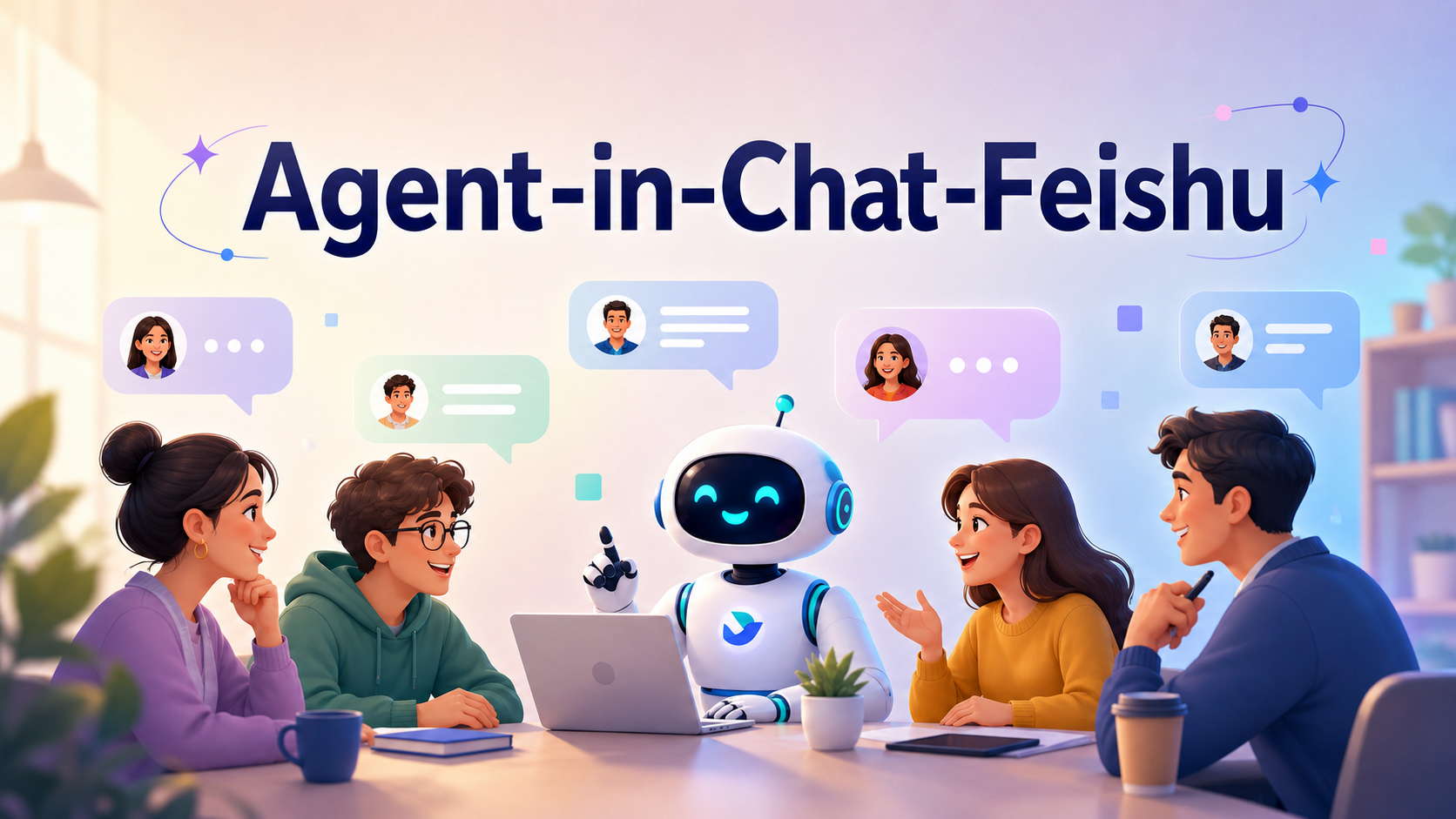
Agent-in-Chat
02 · ContextYour team chat is the workspace.
Bring coding agents into Feishu / Lark. Let them follow the conversation, gather the surrounding context, and get to work when mentioned.
Role in the architectureConversation context: bring team discussions and shared background into agent collaboration.
- Feishu / Lark
- Conversation context
- Multiple agents

ShowAI
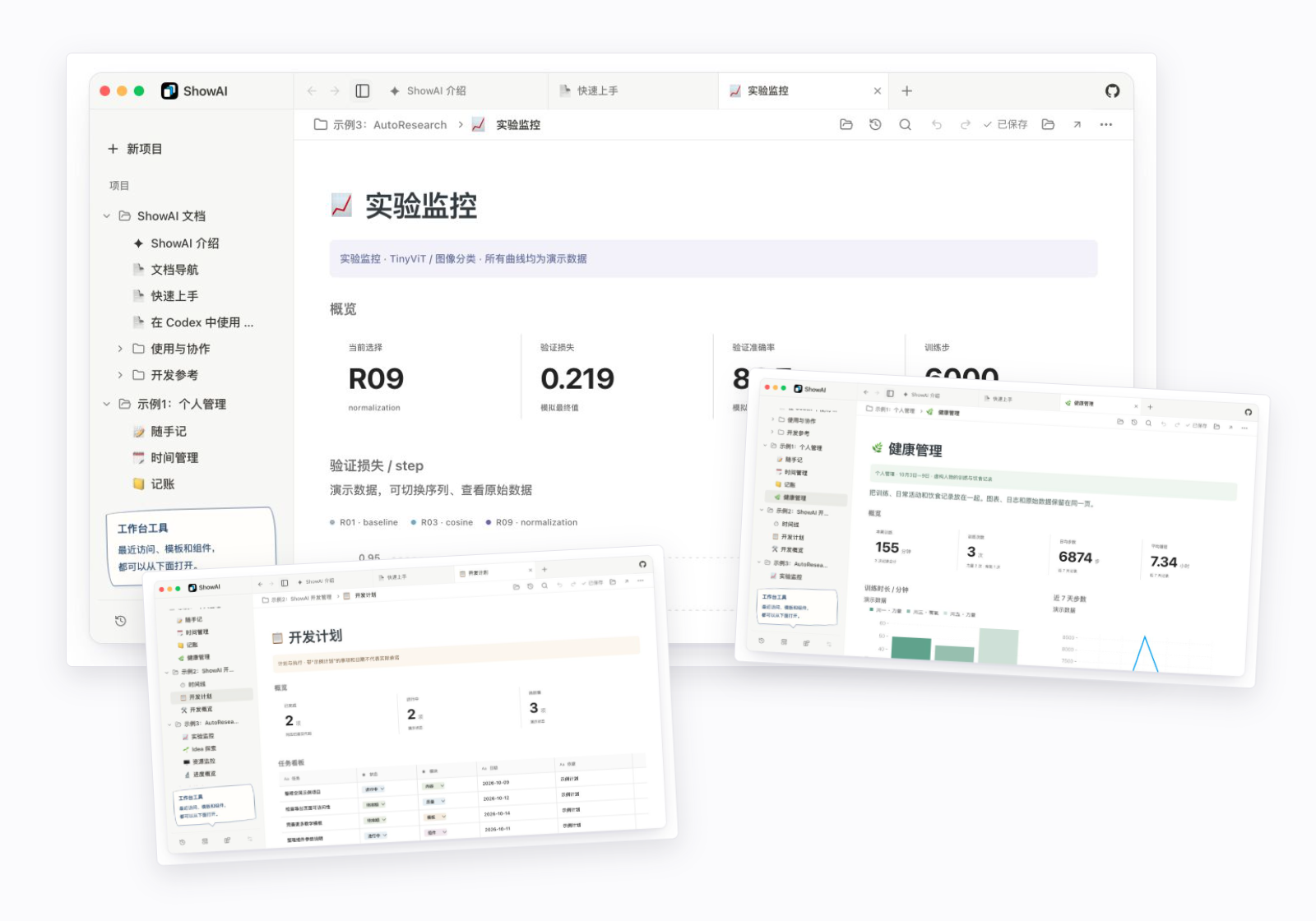
03 · Cognitive AugmentationThink together. Make understanding visible.
Turn information and analysis into pages, charts, and interactive models. Explore, edit, and create alongside your agent in the same shared content.
Role in the architectureA shared thinking interface: humans and agents explore, edit, and form judgments together.
- Interactive pages
- Human–agent co-creation
- Shareable sites

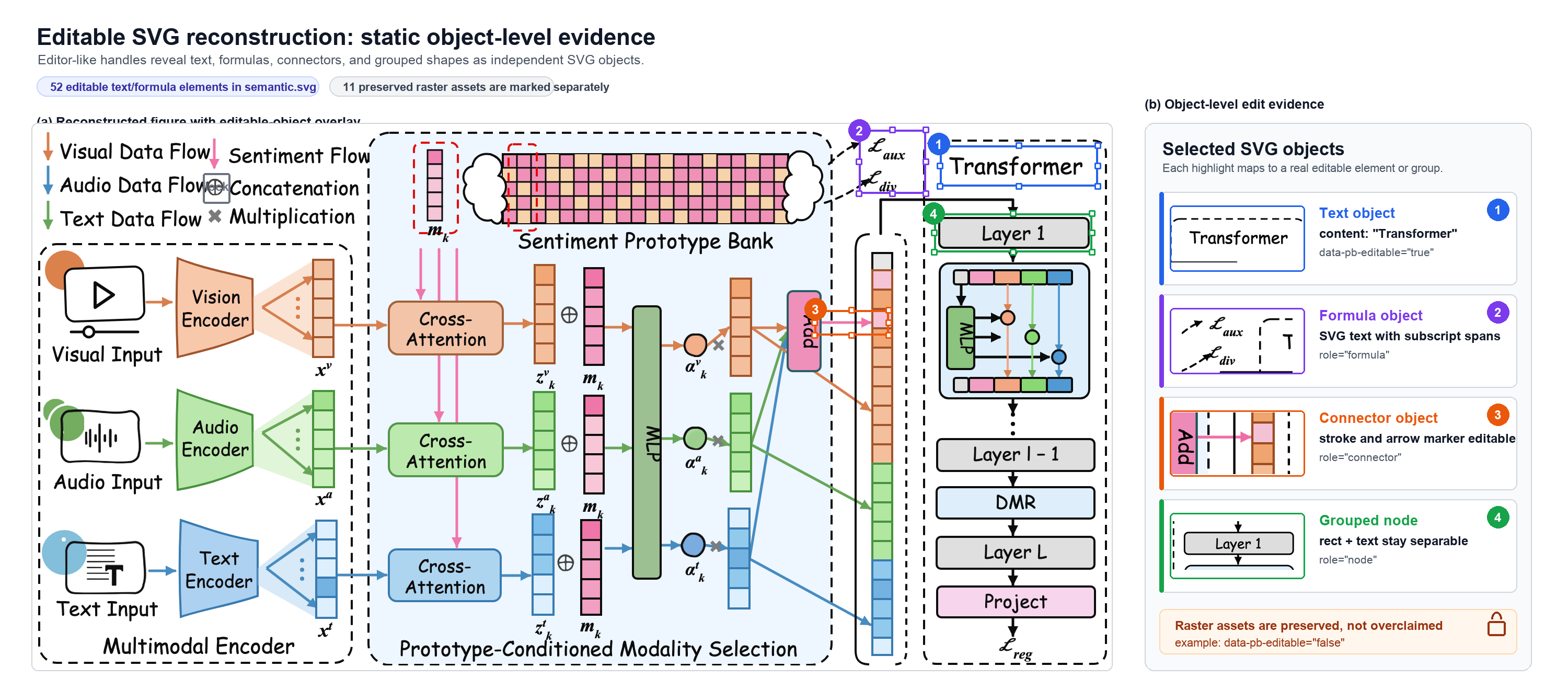
DrawAI
03 · Cognitive AugmentationAn image is only the beginning.
Reconstruct paper figures, technical diagrams, and slide screenshots as editable SVG and PowerPoint files. Keep working on the text, structure, and individual elements.
Role in the architectureEditable representations: recover structure and elements so people can keep creating.
- Image → SVG / PPTX
- Editable elements
- Agent · Workbench · CLI

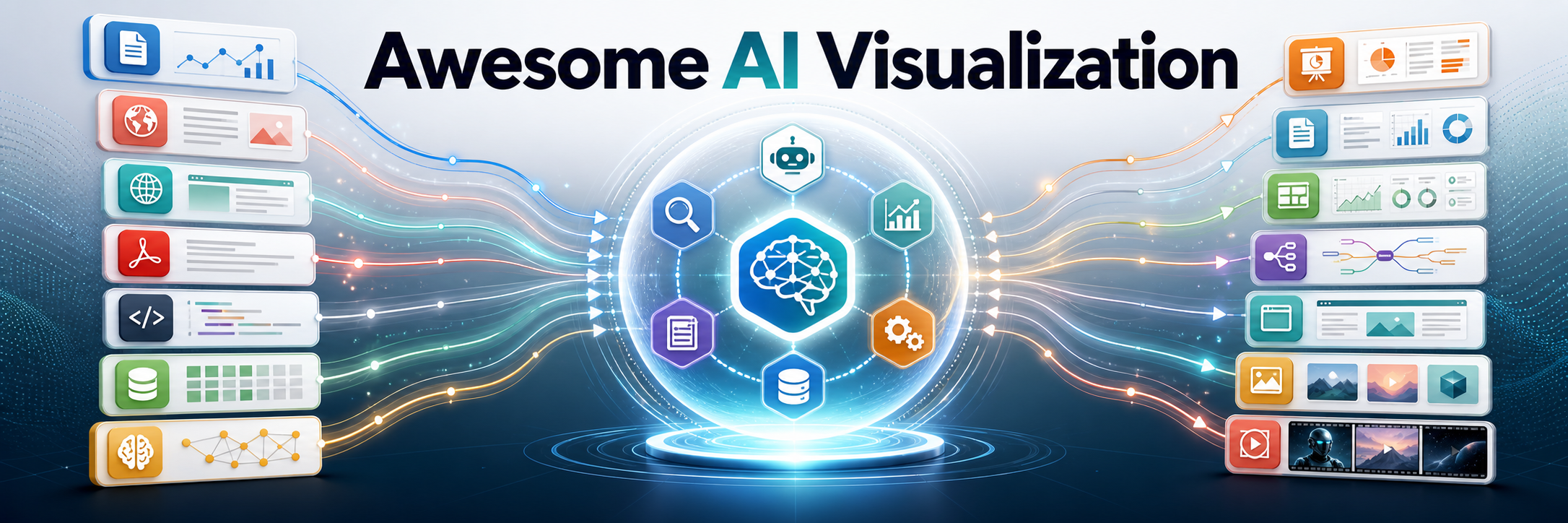
Awesome AI Visualization
03 · Cognitive AugmentationVisualize anything. Understand more.
Explore a curated directory of AI tools, open-source projects, skills, and MCP servers that turn papers, code, data, knowledge, and ideas into visual material people can understand and use.
Role in the architectureA visualization atlas: discover ways to turn complex information into material for understanding and creation.
- Visualization directory
- Tools · Skills · MCP
- Papers · Code · Data
02 / Personal ContextResearch
Context stays under human control.
Agent-in-Chat brings conversation context into agent collaboration. The topics below explore broader personal and project context; they are not separately released applications.
- ME / Context
- A personal model of history, preferences, and memory boundaries.
- Project Context
- Keep project goals, decisions, and constraints coherent over time.
- Chat Context
- Make conversation context selective, inspectable, and bounded.
People direct agent work, inspect its results, and bring new understanding into the next round. Context supports the whole loop.
We believe the future human-AI system should not be just efficient automation, but a cognitive ecology shaped by humans, machines, and the world: pluralistic, coupled, and co-constructed.
PluralisticPluralistic
Human intelligence is not one-dimensional; it is a polyphony across science, humanities, art, and technology. Our team spans BUPT, Tsinghua University, Seoul National University, and Sichuan University, with backgrounds in AI, computer science, art design, and literary criticism. This lets us explore plural paradigms for human-machine collaboration.
CoupledCoupled
Human cognition, machine intelligence, and the physical world are not isolated; they form an entangled network. Their interaction becomes the base architecture of future intelligence. RenaissanceMind explores models, interfaces, and protocols for bidirectional human-machine augmentation and ecosystem collaboration.
Co-constructionCo-construction
Knowledge progress and technology access should not stay behind closed boundaries. RenaissanceMind follows open science and opens its projects under open-source licenses. We invite developers, researchers, and creators to build a more inclusive, interpretable, and extensible human-machine ecology.
Vision
We hope next-generation AI tools become more than productivity engines: cognitive partners for understanding, expression, and creation. In a world shaped by intelligent machines, we work to keep human agency, judgment, and creative freedom alive.